
Financial literacy is often presented as empowerment. But it can also transfer responsibility to consumers when institutions leave avoidable complexity or harmful practices unaddressed. Some critics, such as Lauren Willis, argue that in practice, it can in fact divert attention from market reform.1
Financial education has a legitimate role in inclusion, but only when considered alongside institutional responsibility for the conditions in which consumers make decisions. This article argues for assessing consumer capability together with product quality and market conduct. For communications professionals, that means examining whether information helps people use services and whether the underlying product supports their interests.
Consumer knowledge does not equal empowerment
If an available product is unsuitable or its terms are unfair, no amount of knowledge is going to help the consumer. Understanding a fee does not make it affordable. A policy response focused on knowledge alone can therefore leave the cause of a poor outcome unresolved.
The US Consumer Financial Protection Bureau’s research framework recognises that decision context shapes opportunity and influences individual choices.2 This helps explain why assessments of consumer knowledge should also examine the conditions in which people are expected to act.
For example, a consumer may understand interest but receive essential information too late to compare credit offers. In that situation, a provider should examine the timing and presentation of its information before assuming that more education is the appropriate response.
Consumers need broader capability to make financial decisions
Several frameworks give a fuller picture of what shapes financial wellbeing.
The OECD’s definition of financial literacy comprises financial awareness and knowledge, together with the skills, attitudes and behaviours needed for sound decisions and wellbeing.3
According to the OECD, financial literacy dimensions include:
- Financial awareness: Being aware of the importance of financial decisions and the need for financial planning and management
- Financial knowledge: Knowing about financial products, services, and concepts, such as risks and returns, interest rates, inflation and diversification
- Financial skills: Being able to apply knowledge for important tasks, such as budgeting, saving, investing and managing debt
- Financial attitudes: Having appropriate attitudes about money, including planning for future needs and mitigating financial risks
- Financial behaviours: Doing the right things for sound financial decision-making, such as spending, saving and investing responsibly
Another example is Margaret Sherraden’s framework, which combines the ability to act with the opportunity to act, including access to quality financial products and services.4 This is a useful framework for examining how institutions enable or constrain consumers’ decisions. Within this framework, improving capability can require changes to the services available. Clear information has a practical role, but cannot compensate for an unaffordable charge or an inaccessible service.
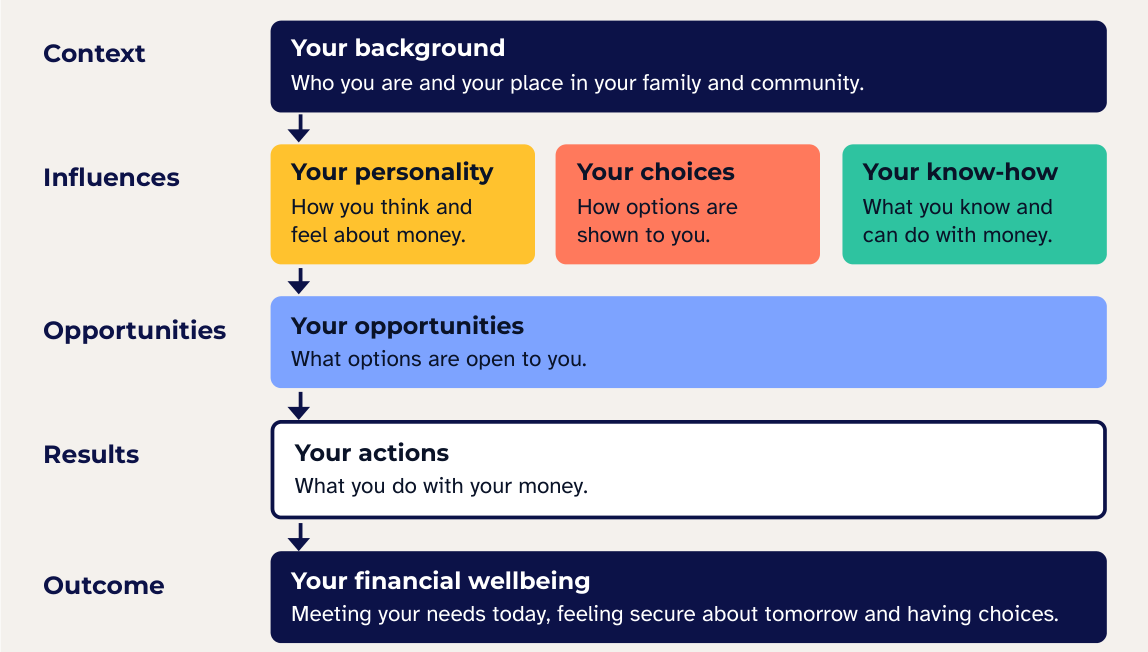
Read a text version of the model
- Context: Your background
- Who you are and your place in your family and community.
- Influences: Your personality
- How you think and feel about money.
- Influences: Your choices
- How options are shown to you.
- Influences: Your know-how
- What you know and can do with money.
- Opportunities: Your opportunities
- What options are open to you.
- Results: Your actions
- What you do with your money.
- Outcome: Your financial wellbeing
- Meeting your needs today, feeling secure about tomorrow and having choices.
Linking capability with market conduct
From a financial inclusion policy perspective, the Alliance for Financial Inclusion or AFI also moves the discussion in the right direction with its recently published Consumer Empowerment and Market Conduct Policy Model. This links consumer capability with market conduct and the institutional arrangements supporting both.5 This connection gives provider behaviour an explicit place in inclusion policy.
The six pillars cover governance, market conduct, supervisory tools, consumer capability, complaints redress and cross-cutting themes.6 Consumer action and institutional responsibilities are correctly connected in this model – showing the multiple drivers that are needed for change.
The guidance extends to practical implementation. AFI describes Malawi’s approach as combining clear onboarding information with practical guidance on complaints.7
Where does this leave financial education?
There is evidence to show the benefit of financial education
All this is not to say that there is no benefit to financial education.
A 2022 meta-analysis of 76 randomised experiments involving more than 160,000 participants found positive average effects on financial knowledge and subsequent behaviour.8 These findings support investment in financial education. They do not establish that education can replace changes to unsuitable products or unfair practices.
But what should we focus on to make as much impact as possible?
Education should address the decisions and circumstances of its intended participants. It needs to start with a deep understanding of the target audience. Then, it should:
- Focus on decisions people face, such as comparing borrowing costs or managing an irregular income
- Build practical skills using the products and information participants will encounter
- Address how people feel about money, including anxiety or low confidence that may prevent them from seeking help
- Help people assess how options are presented, including fees, defaults and promotional claims
- Explain the options genuinely available to participants, taking account of affordability, eligibility and access
- Connect learning to opportunities to act, with support available when people need it
- Assess whether participants can use what they learn and whether it improves their financial wellbeing
Education should also help identify barriers that require changes to financial services, rather than expecting participants to overcome them alone.
What does this mean for financial communications professionals?
ISO 24495, the standard for clear communication, sets out four principles: relevant, findable, understandable and usable. They provide a practical starting point for examining how communications support financial inclusion. We add a fifth area: monitoring and evaluation.
Relevance
Communications should address the decisions consumers face, taking account of their circumstances and the services available to them.
- Establish what intended users need to know, including people currently excluded from services.
- Explain the terms that affect whether a product meets their needs, including costs, eligibility and restrictions.
- Provide information when it can inform a decision, with appropriate language and formats for the audience.
- Identify where the available product or service cannot meet users’ needs, even when its terms are clearly explained.
Findability
Information supports decisions only if people can locate it when they need it. This applies throughout the relationship with a provider.
- Make essential terms easy to locate before consumers commit to a product.
- Organise information around users’ tasks, such as comparing offers, accessing funds or making a claim.
- Make support and complaints routes visible and accessible through the channels consumers use.
- Check that information remains easy to find when consumers move between digital services, staff and agents.
Understanding
Consumers need to understand what information means for their own circumstances. Clear wording should be supported by explanations of practical consequences.
- Explain costs and obligations using examples relevant to the intended audience.
- Make significant conditions explicit, including insurance exclusions, withdrawal restrictions and the consequences of missed repayments.
- Present comparable information consistently so consumers can assess the options available.
- Refer ambiguous or potentially unfair terms to the responsible team. Clearer wording alone cannot resolve an underlying product problem.
Usability and testing with users
Testing should examine whether people can use information to make decisions and complete relevant tasks. It should reflect the circumstances of intended users.
- Include participants with different literacy levels, language needs and experience of financial services.
- Ask participants to apply information, such as calculating a borrowing cost or identifying how to challenge an unexpected charge.
- Investigate whether difficulties arise from the communication, the service process or the product itself.
- Revise the communication or refer the underlying issue to its owner, then test whether the change addresses the difficulty.
Monitoring and evaluation
Evaluation should connect communication improvements to the programme’s inclusion objectives, while distinguishing comprehension from wider outcomes.
- Monitor complaints and incomplete applications to identify recurring difficulties that require investigation.
- Assess whether changes help consumers understand their options and complete intended tasks.
- Examine findings across user groups to identify whose needs remain unmet.
- Combine communication findings with evidence about affordability and product suitability when assessing wider inclusion outcomes.
- Assign responsibility for improvements and use the findings to inform provider practice and programme design.
Notes
- Lauren E. Willis, ‘Against Financial Literacy Education’, draft dated 20 March 2008, pp. 44–49. Author’s draft of the article published in Iowa Law Review, 94(1), 197–285. faircanada.ca/wp-content/uploads/2009/09/A-Case-Against-Financial-Literacy.pdf (accessed 3 October 2026). Return to text
- Consumer Financial Protection Bureau, Financial Well-Being: The Goal of Financial Education, January 2015, pp. 32–33. The report presents a conceptual framework informed by qualitative research and a literature review. files.consumerfinance.gov/f/201501_cfpb_report_financial-well-being.pdf (accessed 3 October 2026). Return to text
- OECD, OECD/INFE 2023 International Survey of Adult Financial Literacy, OECD Business and Finance Policy Papers, no. 39, 2023, p. 6. DOI: 10.1787/56003a32-en. doi.org/10.1787/56003a32-en (accessed 3 October 2026). Return to text
- Margaret S. Sherraden, Financial Capability: What Is It, and How Can It Be Created?, CSD Working Paper 10-17, 2010. repository.library.washu.edu/csd_research/644 (accessed 3 October 2026). Return to text
- Alliance for Financial Inclusion, ‘AFI launches Consumer Empowerment and Market Conduct Policy Model’, 2 September 2026. afi-global.org/news/afi-launches-consumer-empowerment-and-market-conduct-policy-model (accessed 3 October 2026). Return to text
- Alliance for Financial Inclusion, The Consumer Empowerment & Market Conduct Policy Model, September 2026, pp. 3–7. afi-global.org/publication/the-consumer-empowerment-market-conduct-policy-model (accessed 3 October 2026). Return to text
- Alliance for Financial Inclusion, The Consumer Empowerment & Market Conduct Policy Model, September 2026, pp. 10, 15–18. See the Malawi example on p. 16. afi-global.org/publication/the-consumer-empowerment-market-conduct-policy-model (accessed 3 October 2026). Return to text
- Tim Kaiser, Annamaria Lusardi, Lukas Menkhoff and Carly Urban, ‘Financial education affects financial knowledge and downstream behaviors’, Journal of Financial Economics, 145(2), 2022, pp. 255–272. DOI: 10.1016/j.jfineco.2021.09.022. scholarworks.montana.edu/items/a7e2a518-31a6-4632-94cb-018d45402d39 (accessed 3 October 2026). Return to text
© Narratology Marketing Limited 2026. Email info@narratology.co.uk for more information.
How Narratology can help
Narratology helps financial service providers and inclusion programmes identify where communication limits consumers’ ability to make decisions and use services. We combine content strategy with plain-language expertise and user research.
- Communication and customer journey reviews.
- Identify missing information and avoidable complexity, from product comparison and applications to ongoing use and complaints.
- Plain-language assessments.
- Review communications against ISO 24495-1 principles and prioritise improvements according to their consequences for consumers.
- Content design and rewriting.
- Develop product explanations, forms and service messages that help people understand their options and complete their tasks.
- Testing with intended users.
- Establish whether people can find, understand and use information. Identify the changes needed and test whether they work.
- Financial capability programme design.
- Define where education or communication can help, and where progress depends on changes to products or processes.
- Communication policy and governance.
- Establish standards, review responsibilities and approval processes that make consumer understanding part of routine product and service decisions.
- Evaluation planning.
- Define what a communication intervention should achieve and how to assess its contribution to the programme’s inclusion objectives.
- Training for delivery teams.
- Help communications, product and compliance teams apply plain-language principles to their own services and respond to user research findings.
We can review a specific communication, improve a complete customer journey or advise on communication across an inclusion programme.
Contact info@narratology.co.uk for more information.